
What Is Child-Resistant Cannabis Packaging?
Packaging designed to be difficult for children under 5 to open, but accessible for adults. For cannabis products, CR packaging is mandated by the Consumer Product Safety Commission (CPSC) and enforced by state regulators.
Do All Cannabis Packages Need to Be Child-Resistant?
Yes. Flower, edibles, concentrates, vapes, and pre-rolls all require CR packaging. Topicals and transdermals vary by state, but the majority of dispensary SKUs fall under CR requirements.
1. Compliance Is a Business Risk, Not a Checklist Item
A single non-compliant package can trigger:
- Product recalls and destroyed inventory
- State fines ranging from thousands to hundreds of thousands of dollars
- Lost retail relationships and brand damage
Child-Resistant (CR) packaging is what keeps products on dispensary shelves. Skipping compliance means skipping revenue.
2. The Only Standard That Matters: 16 CFR § 1700.20
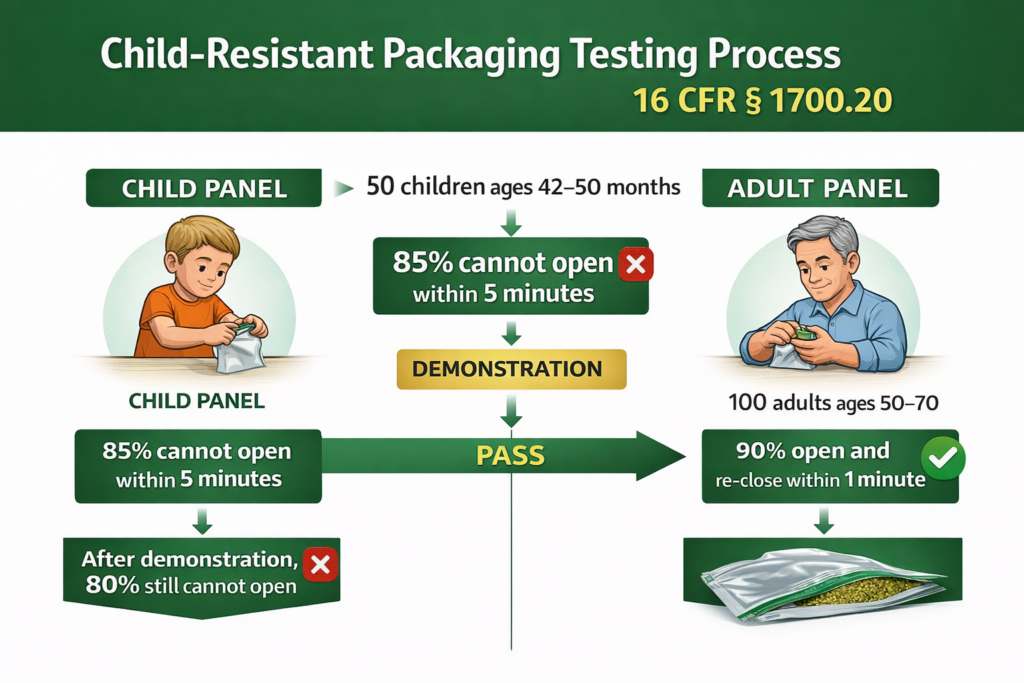
16 CFR § 1700.20 is the federal protocol for child-resistant packaging. No other standard replaces it.
Passing requires two tests:
- Child panel: 50 children ages 42–50 months. 85% cannot open within 5 minutes. After a demonstration, 80% still cannot open.
- Adult panel: 90% of adults ages 50–70 must open and re-close (if applicable) within 1 minute.
What this means for your order:
If your supplier cannot produce a 16 CFR § 1700.20 test report from a CPSC-accredited lab for the exact SKU you are buying, the packaging is not certified. No report = no compliance.
3. CR Mechanisms That Actually Work
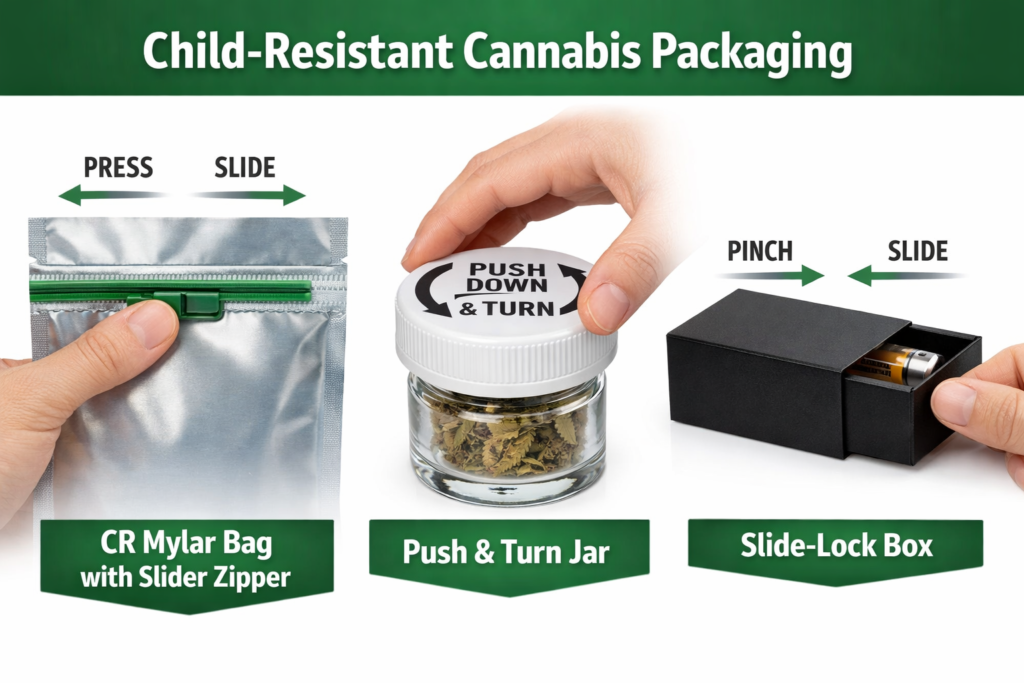
Different product formats require different CR structures. Here is what passes—and what fails.
Mylar Bags (Flower, Edibles)
Pass: Dual-track zipper with a rigid slider requiring two distinct movements to open.
Fail: Press-to-close zipper without a slider. Tear-notch only.
Material matters too. A CR mechanism on a bag that tears easily is worthless. Multi-layer laminates (PET/Aluminum/LLDPE) provide puncture resistance and smell-proofing.
Concentrate Jars
Pass: Push-down-and-turn (PDT) lid with a dual-wall ratchet system.
Fail: Standard screw lid without a ratchet. Single-wall lids that do not require downward pressure.
Cartridge & Pre-roll Boxes
Pass: Slide-lock box with an internal tab requiring side-squeeze while sliding.
Fail: Standard tuck box. Paperboard that bends under pressure.
Before ordering: Request physical samples. Many suppliers copy the look of CR packaging but deliver mechanisms that fail during adult usability testing. If the mechanism does not work consistently, dispensaries will reject it.
4. Material Integrity: ASTM D3475
CR certification does not stop at the mechanism. ASTM D3475 covers material durability—ensuring the package stays child-resistant through its lifecycle.
What to verify:
- Puncture resistance: Multi-layer laminates prevent tears. Single-layer materials fail.
- Heat seal integrity: A weak seal creates a failure point that voids certification.
- UV protection: Not a CR requirement, but prevents material degradation that could compromise the closure over time.
When comparing quotes: Ask for material specifications. A lower-priced mylar bag may use a single-layer laminate that passes initial visual inspection but fails puncture testing—invalidating your CR status.
5. “Compliant” vs. “Certified” — Know the Difference
| Term | What It Actually Means | Risk |
|---|---|---|
| “Compliant” | Supplier claims the design is intended to meet standards. No lab test required. | High |
| “Certified” | Package passed CPSC-accredited lab testing under 16 CFR § 1700.20. Report available. | Low |
If a supplier cannot produce a lab certification for the SKU you are ordering, there is no proof of compliance. State regulators do not accept “we designed it to be compliant.” They require test reports.
6. State Requirements Are Not Uniform
Federal testing sets the baseline. States add their own rules.
| State | Additional Requirement |
|---|---|
| California (DCC) | Packages must remain child-resistant after adult re-closure. Slide-lock boxes and dual-track mylar zippers pass; simple PDT lids often fail re-closure testing. |
| Oregon (OLCC) | Warning labels must be printed directly on the package. Stickers are not accepted for certain required markings. |
| New York (OCM) | Packaging cannot appeal to children. Bright colors, cartoons, and characters are prohibited regardless of CR mechanism. |
Before placing an order: Confirm your supplier knows the specific state requirements for your retail locations. A package that passes in Oregon may fail California re-closure testing.
Conclusion: Packaging That Passes—or Liability That Costs
Child-resistant packaging is not a cost center. It is what keeps products on shelves and brands out of compliance notices.
If your current supplier cannot provide:
- Certified 16 CFR § 1700.20 test reports
- Material specifications (ASTM D3475)
- Documentation matched to your SKU
Then your packaging is a liability.
Request a Free Compliance Review
Get verified, certified child-resistant packaging that passes state audits and dispensary QA.